
Role
Product Designer
Timeline
4 months
Scope
Research, UX/UI Design, Product Strategy
A centralized platform that simplifies administrative workflows for language schools by integrating BAMF and reducing manual data entry. Managing integration courses often involves fragmented systems, manual reporting, and error-prone processes. This project focuses on streamlining these workflows, improving data accuracy, and enabling administrators to work more efficiently.
Problem
Language schools running integration courses must manage large amounts of administrative data, including participant records, course schedules, attendance tracking, and government documentation.
Many institutions still rely on spreadsheets or fragmented software systems, which makes these workflows time-consuming, difficult to manage, and prone to errors.
As a result, administrators spend a significant amount of time on manual tasks instead of focusing on improving the learning experience.
Key challenges
Administrative data spread across multiple tools
Manual preparation of government documentation (BAMF)
High risk of data inconsistencies and errors
Solution
To address these challenges, I designed a centralized administrative platform that consolidates student data, course management, and BAMF reporting into a single system.
The solution focuses on reducing manual work, minimizing errors, and improving efficiency for administrators.
Key objectives
Reduce manual data entry and administrative workload
Streamline BAMF-related documentation and reporting
Provide a clear overview of courses, participants, and progress
Centralize all administrative data into a single system
Dashboard view
Provides administrators with a real-time overview of courses and schedules, reducing the need to switch between multiple tools and improving operational visibility.

It was important to present the key features in a single view for iteration. Users need quick access to ongoing and upcoming modules, with options to filter them. From here, module details can be copied and shared with students who submitted inquiry forms. The dashboard also provides an overview of pending BAMF notifications and invoices, making it not just informational but interactive.

Student details
Displays verified participant information retrieved directly from BAMF. Administrators can review and import student data in one step, eliminating manual entry and reducing the risk of errors.
One of the most important features is importing student details from BAMF. After submitting an inquiry using the PKZ/BVA number and date of birth, you receive the student’s information to review. If needed, you can import the student into the system and later edit their profile.
Course management
Enables administrators to manage course schedules, monitor participation. Filtering and status indicators make it easy to navigate large datasets and maintain an overview of all active and planned courses.

Here you have an overview of all courses. You can filter them by INT or course number, status, or module. You can also create a new course or submit an inquiry to find it in BAMF.
Users
5W Method
Who
Admin staff, teachers and school owners (often small or mid-sized integration course providers)
What
Need to enroll participants, schedule courses, manage BAMF reporting, reduce manual work
Where
School offices or administrative workstations
When
Daily administrative workflows during working hours
Why
To streamline administration, ensure BAMF compliance, reduce stress and paperwork
Research
To better understand the challenges faced by language schools, I analyzed existing administrative workflows and reviewed how schools currently manage participant records, course schedules, and government documentation. The research focused on identifying inefficiencies in existing processes and opportunities to simplify administrative tasks through digital tools.
integ.service
SIMILAR FEATURES
SEPA transfers
Attendance overview
Form letters
Participant information
Course administration
Exams management
BAMF integration
Confirmations and certificates
Conversation notes
UNIQUE FEATURES
User rights system
Location distance calculation
Data protection compliance
PRICING
no info
OPPORTUNITIES
Last update in 2008; the company currently doesn't exist, but there are various ideas that we can explore and incorporate into our opportunitiesce
GENERAL NOTES
Simplifies financial workflows related to integration courses by helping administrators manage payments, generate invoices, and track funding from BAMF or other sources — all in one place.
Kufer
SIMILAR FEATURES
Efficient data management
Seamless BAMF form submission
Document management
Access to approved language course forms
Daily attendance recording
Fee billing against BAMF
Travel reimbursement
Custom confirmations and certificates
Lists and evaluations
Appointment management
UNIQUE FEATURES
Course template efficiency
Course material management
Room availability suggestions
Teacher absence management
Room reservation system
Lecturer schedule management
PRICING
Upon request
OPPORTUNITIES
Software integration (for extra fee)
GENERAL NOTES
Numbers of users:1,800 course providers; around 75 percent of all German adult education centers (Volkshochschulen)
Stepnova
SIMILAR FEATURES
Direct reporting to BAMF
Participant list creation
Registration handling
Direct BAMF communication
Transaction overview
InGe interface connection
Data export
BAMF information function
Attendance documentation
Database management
Placement test documentation
UNIQUE FEATURES
Participant enrolment
Course start notifications
Data migration
PRICING
Basic System Pricing:
99 € per month for the basic system, including user access
27 € per month for each additional user access
5 € per month for read-only access
Free support after training
Free trial month
OPPORTUNITIES
Software integration (for extra fee); blog
GENERAL NOTES
Simplifies financial workflows related to integration courses by helping administrators manage payments, generate invoices, and track funding from BAMF or other sources — all in one place
Kurso
SIMILAR FEATURES
Participant registration
Participant information
Course planning
Course implementation
Language test registration
Quota and lesson section monitoring
Teaching hours documentatio
Certificate release
Exams administration
UNIQUE FEATURES
Automated invoicing
Section-based payment plans
Cash receipt monitoring
Invoice corrections
Feature mapping
Waiting list registration
PRICING
Upon request
OPPORTUNITIES
Blog, send group emails and SMS messages
GENERAL NOTES
Multiple use of a user account by several people is not permitted
Kursdatis
SIMILAR FEATURES
Participant information
Travel expense management
Attendance list
Billing and cancellation automation
Teaching unit tracking
User access control
Class register maintenance
Participant overview
UNIQUE FEATURES
Reporting and communication system
Attendance percentage display
PRICING
1 to 3 course locations: EUR 49 net/monthly
4 to 9 course locations: EUR 99 net/monthly
10 or more course locations: Price on request
No subscription; can be canceled at any time
OPPORTUNITIES
Onboarding tutorials (video)
GENERAL NOTES
Onboarding tutorials (video)
To better understand the challenges faced by language schools, I conducted a short survey among administrators and staff working with integration course management. The survey focused on communication with BAMF, administrative workflows, and the tools currently used for course management.
+ 10 more questions
+ 15 more respondents
How effective are the current communication channels between your institution and BAMF regarding course administration and compliance requirements?

Yes, communication is clear and regular
Communication is generally effective, but could be more timely/frequent
Communication is inconsistent
Better communication channels are needed
How challenging is it to track student attendance and progress using your current processes?

Very time-consuming and error-prone
Time-consuming but manageable
Minor inefficiencies only
No significant issues
How satisfied are you with the current school administration system for integration courses?

Very Satisfied
Satisfied
Neutral
Dissatisfied
Very dissatisfied
Are you currently using any digital tools or software to manage integration courses and communicate with BAMF?

Yes
No
How do you currently manage course administration?

Manually (paper or Excel)
InGe-Online
Custom internal system
Commercial software
Other
Which features would provide the greatest value to your institution?

Digital attendance tracking
Automated BAMF reporting
Centralized document management
Messaging/communication with BAMF
Course scheduling and administration
Key insights
The research revealed several recurring challenges faced by language schools managing integration courses. Administrators struggle most with fragmented data and manual reporting. This directly informed the decision to centralize dashboards and automate BAMF integration. Administrators often rely on multiple disconnected tools to manage participants, schedules, and documentation. These fragmented workflows increase administrative workload and make it difficult to maintain accurate data.
Key insights
Administrative data is spread across spreadsheets and different systems
Existing solutions are often complex, not tailored to integration course requirements or expensive
Preparing BAMF documentation requires repetitive manual work
Administrators lack a clear overview of participant data
Most respondents reported that administrative workflows rely heavily on manual processes or fragmented systems, confirming the need for a centralized platform.
Core features
Based on the research findings, I designed Sprachschul-Admin, a cloud-based platform that centralizes administrative workflows for language schools running integration courses. The system provides administrators with a single interface to manage participants, courses, attendance, and government documentation. By consolidating these processes into one platform, the solution reduces manual work, improves data consistency, and simplifies reporting tasks required for BAMF compliance.
User flow
Primary Workflow: Student Import via BAMF
One of the key workflows in the platform is importing a student from the BAMF database. This flow was designed to reduce manual data entry and simplify the process of enrolling participants into the system.

Design system
Using Ant Design as a Foundation
To ensure consistency and accelerate development, I used Ant Design as the foundation for the interface.
This allowed me to focus on solving complex administrative workflows while maintaining a scalable and consistent UI.
Ant Design was selected for its strong support of data-heavy interfaces, making it well-suited for administrative systems.
Customisation
While using Ant Design components, I adapted them to better support the platform:
Simplified form layouts for faster data entry
Customized tables to handle large datasets
Adjusted spacing and hierarchy for readability
Reduced visual complexity for non-technical users
Typography
Avenir Next Cyr

Regular
Medium
Bold
Colors

violet-6
#5d64e7
rgb(93,100,231)

red-6
#ff4d4f
rgb(255,77,79)

orange-6
#faad14
rgb(250,173,20)
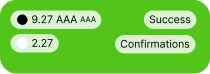
green-6
#52c41a
rgb(82,196,26)
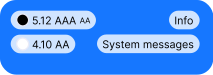
blue-6
#1677ff
rgb(22,119,255)
Components
Buttons
Primary
Secondary
Form inputs
Geburtsdatum
10.07.1988
Handynummer
+49
Eingaben
Staadtangehörigkeit
Ukraine
Modals
Teilnehmer finden
Gebe PKZ & Geburtdatum an, um in der BAMF-Datenbank nach einer Person zu suchen.
*
PKZ/BVA-Aktenzeichen
Eingeben
*
Geburtsdatum
Datum auswählen
Abrechen
BAMF-Details ansehen
Tables
Unterrichtszeiten
Impact
The final interface streamlined administrative workflows by centralizing data and reducing reliance on manual processes. Significantly reduced manual administrative effort and streamlined participant management workflows
While no formal usability testing metrics were collected, the design decisions were guided by identified pain points and validated through realistic workflows and system constraints.
Reflection
This project highlighted the challenges of designing for complex, data-heavy administrative systems.
One of the key learnings was the importance of simplifying workflows without removing necessary functionality.
Working with a component-based system (Ant Design) influenced my approach by encouraging consistency and scalability from the early stages of the design process.